India: The Overlooked Growth Story in Global Investing
For many Swiss investors, India remains a sideshow. Yet the country offers enormous economic potential and deserves closer attention from an investment perspective as well. Four experts laid out the case at an event hosted by Rootbridge and finews.
India is catching up fast. The country is already among the world’s five largest economies, with growth rates that are hard to ignore. And the potential remains substantial. With a population of around 1.4 billion, the world’s largest democracy still has significant ground to make up on a per-capita basis.
Yet India does not rank high on the priority list of most Swiss investors. Those who do invest typically gain exposure via their emerging markets allocation, where Indian equities already account for around 20 percent of the MSCI EM index.
A sideshow
So what argues for taking a closer look at this former «sideshow?» What should investors be mindful of? And what impact will the free trade agreement between Efta (and thus Switzerland) and India, which entered into force on October 1, 2025, have?
To explore these questions, India-focused private-equity firm Rootbridge and finews invited guests on Thursday evening to Zurich’s Zunfthaus zur Saffran. The timing was deliberate, coinciding with the week of India’s national holiday, Republic Day on January 26. Judging by the audience welcomed by Dominik Buholzer, editor-in-chief of finews, interest in the topic is clearly growing in Switzerland as well.
From culture and communication to trust
The panel, carefully moderated by finews publishing director Florian Schwab, brought together four personalities with deep and diverse India expertise, while keeping the Swiss investment perspective firmly in focus.
Suki Dusanj-Lenz, founder and CEO of Once Upon a Media, has spent decades building bridges and networks between European and Indian businesses. She urged investors to engage seriously with cultural and communication differences when investing in India — and to view them as an asset. “Only in this way can the trust that is indispensable for business relationships be built,” she said.
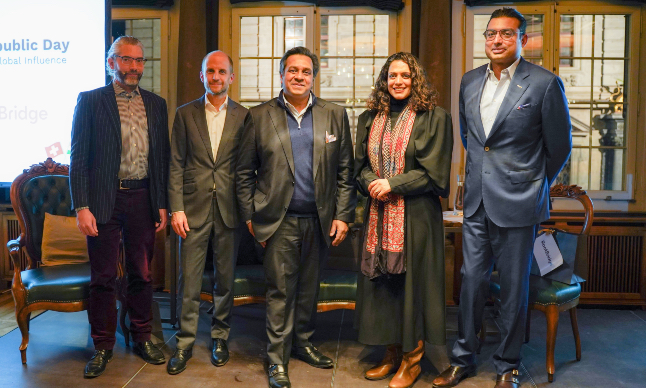
From left to right: Florian Schwab, Reto Cueni, Ajay P. Singh, Suki Dusanj-Lenz, Nayan Srivastava (Image: Mischa Vasylyev)
Reto Cueni, long active in senior economist roles at Vontobel and, since 2025, chief economist at Bank Syz, is deeply familiar with the realities of Swiss wealth management. He noted that India is steadily gaining ground on China — a country that receives far more attention in global portfolios — primarily for demographic reasons. At the same time, he cautioned that India’s economy remains strongly domestically oriented.
The panel also included Rootbridge Capital co-founders Ajay P. Singh and Nayan Srivastava, who have been investing jointly in Indian private equity since 2009. Singh argued that Western investment professionalism should be deployed to unlock the potential of India’s countless small and mid-sized enterprises, many of them family-owned.
Both Singh and Srivastava acknowledged how challenging it remains to convince Swiss investors of the merits of India. Srivastava described it as an «uphill battle» he fights every day — while insisting that India should be an indispensable building block in any well-diversified portfolio.
A gap in corporate-finance banking?
During the lively Q&A session, one audience member raised a point of broader relevance for Switzerland’s financial centre: since Credit Suisse’s exit, there is no longer a Swiss commercial bank active in India — and conversely, no Indian commercial bank operating in Switzerland.
The apéro that followed offered ample opportunity to continue discussions on India’s investment potential and opportunities — as well as on the pitfalls investors would be wise to avoid.