

From the New World: Pleasure, Cigars and the Dominican Republic
finews travelled to the Caribbean to explore the Dominican Republic through the lens of pleasure and tobacco culture. The highlight is a visit to Santiago de los Caballeros, where some of the world’s finest cigars are rolled.
The essence of colonial Santo Domingo, as of almost any city, is best discovered on foot. A leisurely walk along «Calle de las Damas,» the oldest paved street in the New World, becomes a demanding exercise in historical compression.
The «Ciudad Colonial» of the Dominican capital is in remarkably fine shape: façades are carefully maintained, and the houses’ sunlit Caribbean colors lend the scenery an almost unreal quality. The architecture is playful, confident and unmistakably Caribbean. Low colonial buildings, shaped by time and humid heat, bear discreet plaques pointing to former residents and long-faded authorities.
A Sense of Imperial Grandeur
An unassuming building along Santo Domingo’s promenade notes that it was the last residence of Christopher Columbus in the Americas. Santo Domingo was the epicentre from which the discovery and conquest of the entire «New World» was organized and set in motion, driven by imperial ambition and the promise of vast gold and silver riches.
Santo Domingo was no colonial outpost; it was the point of departure. From here, the Spanish Crown administered its entry into Latin America. Diego Columbus, son of Christopher Columbus, resided as the fourth Governor of the «Indies» in a palace whose scale still conveys a sense of early imperial grandeur.
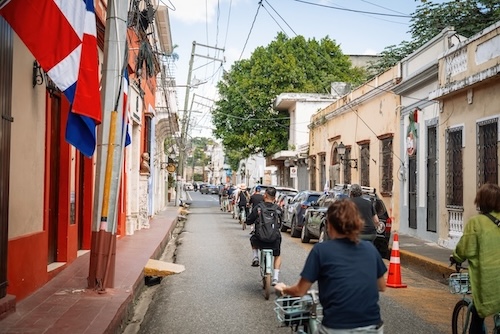
In the streets of Santo Domingo. (Image: Courtesy)
First Stop on the Way West
Licenses for gold expeditions were issued here. Santo Domingo was the first station on the route toward the continent: Mexico, Colombia, Argentina.
Regardless of one’s historical assessment of colonialism, its legacy is omnipresent in the city. Its ambivalent weight becomes tangible, its face visible in stones, streets and countless monuments.
Champagne at the Billini Hotel
Our guide’s vivid descriptions of the administrative machinery of colonial expansion, the slave market at the heart of the city, ecclesiastical power and maritime ambition merge with the tropical heat into an experience that begins to shimmer with every glass of rum and every cigar.
It is best met later in the day with a bottle of champagne on the rooftop terrace of the «Billini Hotel,» undoubtedly one of the city’s most elegant vantage points.
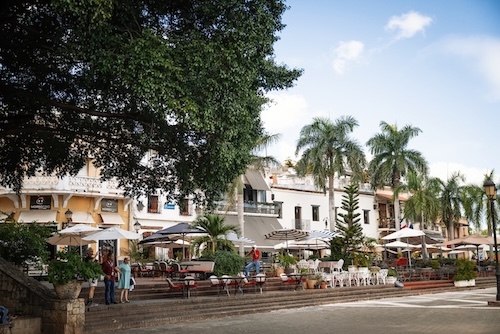
Colonial architecture in the Dominican capital. (Image: Courtesy)
A Living Archive of Rum and Cigars
This stopover feels like entering a living archive. The boutique hotel occupies a carefully restored colonial building opposite the «Iglesia y Convento Regina Angelorum,» a Dominican foundation dating back to the 16th century and one of the earliest convents for nuns in the New World.
The church’s restrained stone façade and monastic austerity form a calm counterpoint to the colors and vibrancy of the «Ciudad Colonial.» There is no escape from history here—only different ways of inhabiting it.
A Countermodel to Cuba and Haiti
And yet, finews did not travel to Santo Domingo to dwell on the past and its colonial and post-colonial fault lines. Those are visible nearby—in Haiti and Cuba, countries shaped by political isolation, economic decay and structural poverty, existing at the margins of the modern global order.
By contrast, the Dominican Republic stands apart: long aligned with the United States, economically more resilient and visibly more prosperous.
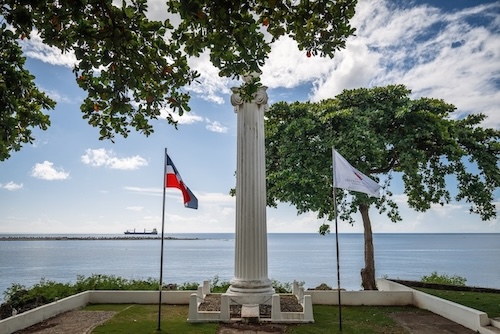
View of the Caribbean Sea. (Image: Courtesy)
«Grüeessch» in Santo Domingo
But that is not the purpose of this journey. It is about something else: the Dominican Republic’s distinct Caribbean joie de vivre. It manifests itself in a festival of intense flavors, rum in generous abundance and, above all, in a cigar industry that has by now surpassed its Cuban prototype. In 2022, the island even declared tobacco culture part of its national cultural heritage.
One of the most compelling crystallization points of this identity is «Restaurant Casarré,» where Swiss-Dominican restaurateur Olivier Bur celebrates biodiversity and culinary heritage with understated elegance. The greeting feels unexpectedly familiar—a warm Swiss «Grüeessch», the customary Swiss-German greeting of the canton of Berne—before dishes arrive that translate Caribbean abundance into disciplined creativity.
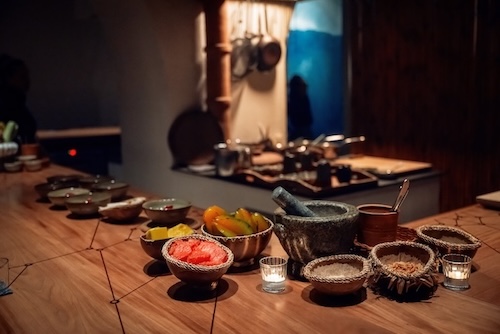
Autochthonous flavors at the chef’s table of «Restaurant Casarré.» (Image: Courtesy)
The «Colmado» Experience: Social, Joyful and Deeply Rooted
The following day, we follow our guide’s advice and seek out the uncurated. On almost every second street corner, a «colmado» appears—a Dominican blend of neighborhood meeting point, grocery store and bar. This is where people eat, drink and talk.
We order the Bandera Dominicana: rice, beans and pork, crowned with chicharrón—deep-fried pork fat with just enough meat left to justify indulgence. Simple in composition and unapologetically generous in spirit, the dish easily delivers three to four times the calories of a Zurich hipster lunch. It is not haute cuisine, but it is social, joyful and culturally deeply rooted.
Onward to Santiago de los Caballeros
But enough of Santo Domingo—of colonial stone, rooftop champagne and Christopher Columbus. A different, perhaps even more inspiring form of appeal and pleasure unfolds elsewhere. The next and central destination of our journey takes us inland, away from the coast and its touristic allure, to Santiago de los Caballeros.
The drive takes around four hours. It leads away from humid sea air into a landscape shaped more by agriculture than tourism. The climate changes perceptibly. Mornings are misty, temperature swings over the day more pronounced—precisely the conditions tobacco loves.
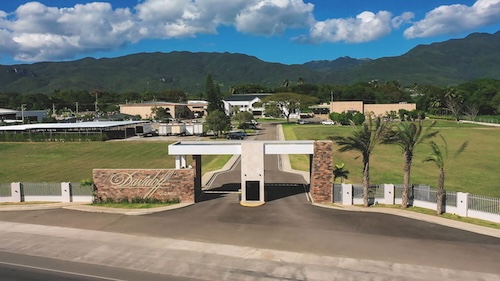
Pioneering site: «Tabadom» headquarters in Villa Gonzalez near Santiago. (Image: Courtesy)
Epicentre of the Cigar Industry
Santiago is the undisputed heart of the Dominican cigar industry. This is where we seek to understand the essence of «Oettinger Davidoff»'s success in the Dominican Republic.
The contrast between the two cities is striking. Santo Domingo is polished history, carefully restored and confidently staged. Santiago is pragmatic, industrial, agricultural. In the world of cigars, the difference is akin to Paris versus Reims, the capital of Champagne: cultural grandeur here, productive mastery there.
Productive Mastery
Five decades ago, the Dominican Republic barely featured in discussions of premium hand-rolled cigars. At the time, the Cuban Habano defined global standards of smoking pleasure. That hierarchy has since shifted.
A key driver of this change was a strategic decision taken by Swiss company «Oettinger Davidoff» in the early 1990s: moving the production of Davidoff cigars from Cuba to the Dominican Republic. In Cuba, the state tobacco monopoly’s tightening grip had become untenable for internationally oriented producers.
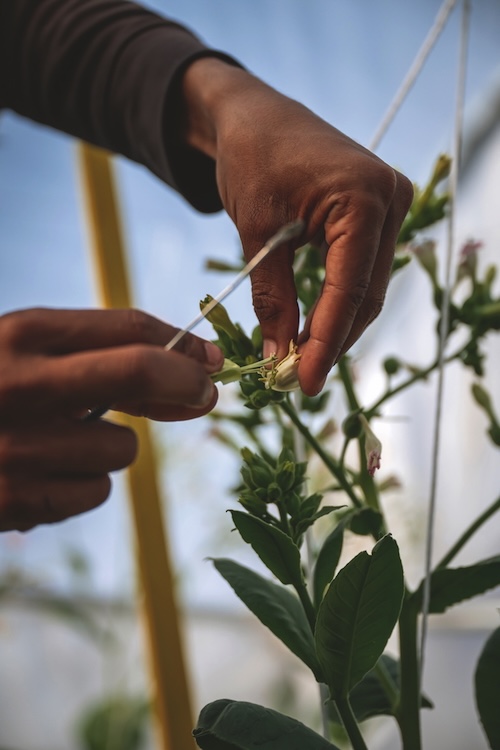
Agronomic precision at the flower. (Image: Courtesy)
From Cuba to Santiago: A Successful Relocation
This move was driven by Dr. Ernst Schneider (1921–2009), then owner and chairman of «Oettinger Davidoff.» It was a decision that would permanently reshape the global cigar industry.
Today, «Oettinger Davidoff» generates export volumes comparable to those of Cuba’s entire state monopoly, Habanos. And the operational heart of that success beats at our destination near Santiago de los Caballeros: «Tabadom,» the group’s Dominican subsidiary, and the nearby «Finca Dr. Ernst Schneider,» its agronomic model farm.
Visiting the «Finca Dr. Schneider»
We are accompanied by Hamlet Espinal, managing director of «Tabadom» and Head of Global Production at «Oettinger Davidoff.» Efficient and quietly authoritative, he appears perfectly cast as a cultural bridge between Santiago’s tobacco-farming tradition and connoisseurs in New York, Hong Kong or Zurich.
Among the region’s many renowned cigar producers—names such as «La Aurora», «Arturo Fuente» or the Reyes family—Davidoff stands apart. Not through folklore or nostalgia, but through industrial discipline paired with artisanal ambition.
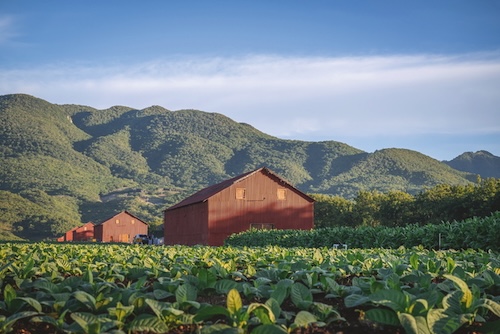
The «Oettinger Davidoff» model farm in the Dominican Republic. (Image: Courtesy)
Cultivated from the Tiniest Seeds
At the «Finca Dr. Ernst Schneider,» Espinal explains the science behind what many cigar lovers romantically call «terroir.» Tobacco cultivation begins with seeds so small they appear almost abstract. One gram of tobacco seeds—disintegrating in the hand like ash—can easily contain up to 15,000 seeds.
They are first nurtured into seedlings in tiny humus pellets, raised in greenhouses and then transplanted to open fields. «Oettinger Davidoff» maintains an extensive genetic archive of tens of thousands of seed varieties—a living library enabling an extraordinary spectrum of flavors across plots and decades.
Tobaccos Dating Back to the 1990s
Fermentation, Espinal notes, is the stage where character either emerges or is lost. Leaves dry slowly under tightly controlled conditions. Temperature, humidity and timing must align precisely. When they do, the green leaf transforms—turning brown, supple, almost translucent, acquiring the silky texture that defines premium cigars.
Rolling, however, remains a domain of human mastery. For its blends, «Oettinger Davidoff» draws on extensive reserves of aged tobacco from different vintages—some dating back to the 1990s—and parcels.
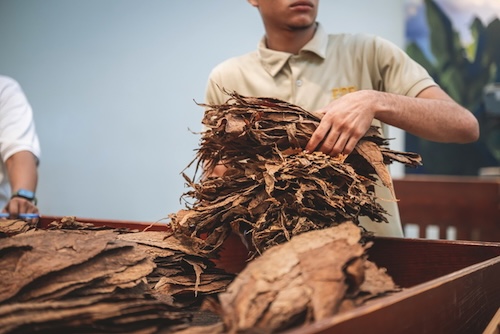
The silky texture characteristic of premium cigars. (Image: Courtesy)
Demanding Craftsmanship
Only the most experienced torcedores, as master rollers are known here, are entrusted with the «Davidoff» name. Watching them work is a lesson in humility. Our own attempts to shape the silky leaves into something resembling a cigar quickly dissolve into approximation.
The highlight of the visit is the enjoyment of a cigar created for a very special occasion: the «Limited Edition 150 Years Oettinger Davidoff.» Produced in a strictly limited run of 400 boxes exclusively for the Swiss market, it distils the company’s philosophy.
The cigar was created last year to mark «Oettinger Davidoff»’s 150th anniversary (as finews reported). Founded in Basel in 1875, long after the discovery of the New World, the company’s global reputation rests on the name of legendary Geneva cigar merchant Zino Davidoff (1906–1994) and the entrepreneurial foresight of Dr. Ernst Schneider.
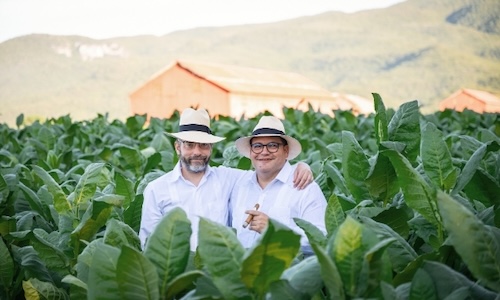
In the tobacco fields: «Oettinger Davidoff» production chief Hamlet Espinal (right) with finews author Florian Schwab. (Image: Courtesy)
The Basel–Santo Domingo Axis
Together with Hamlet Espinal, we experience the sensory and cultural force of this cigar. Overlooking Santiago de los Caballeros, its layered aromas unfold over the course of an intensely savored hour.
Every new «Davidoff» cigar passes through a lengthy process of iteration. Prototypes travel back and forth between the Dominican Republic and Basel, refined repeatedly until balance, aroma and structure align.
Experiencing a Cultural Asset
Some cigar aficionados believe that full enjoyment is only possible in the humid tropical air of the Caribbean. We are inclined to agree. Only by witnessing the agronomic and artisanal effort behind the apparent ease of smoking pleasure can one truly appreciate the cigar as a cultural asset.
With a glass of rum in hand, carried by the sweet, tobacco-laden evening air, it becomes clear why this combination works so convincingly: Swiss precision provides structure, Caribbean emotion gives it soul.