Independent Asset Managers Rival UBS
New SAM Director Takes the Stage
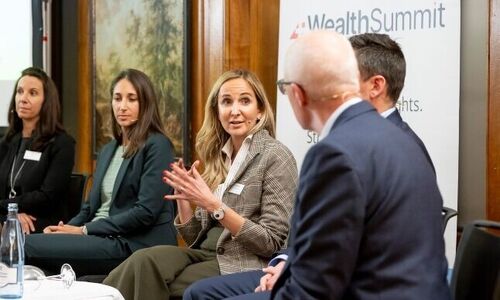
In the second panel, focused on prospects, Vivien Jain, the new CEO of the Swiss Association of Wealth Managers (ASM), approached the often-cited consolidation pressure with composure.
Rather than embracing the narrative of inevitable concentration familiar from private banking, she emphasized the sector’s diversity. Reality, she argued, is more heterogeneous than commonly suggested.
Fresh Note
Jain distanced herself from the often categorical consolidation thesis. More broadly, her appearance marked a notable shift in tone. In a sector that, as the study shows, remains more than 90 percent male, she stood out with clear and independent positions.
Not without irony, she remarked that private equity has struggled to gain a foothold in the IAM succession market: For them, «it is not big business», she said.
Investment Capabilities
Ronny Gwerder of Wellington Management Switzerland highlighted rising demands on the investment side. Differentiation increasingly depends on investment capabilities, as clients expect global perspectives and informed views on complex topics ranging from geopolitics to new asset classes. The key question, he said, is «how to bring these capabilities into your own organization and with whom you partner.»
Headhunter Thomas Bossard (Stellar Executive Search) focused on talent and client advisors, seeing little fundamental difference between banks and independent managers. In both cases, the client experience is decisive — although IAMs are structurally closer to the client.
Foreign IAMs Targeting Switzerland
Carine Frick-Delaloye, head of business development at Aquila, expressed confidence in her firm’s role as an infrastructure provider. While fewer relationship managers may be leaving banks than in the past, demand for independent structures remains strong. She is currently observing increased interest from foreign IAMs seeking to establish a presence in Switzerland, as well as ongoing exits and restructurings within the sector.
Geopolitics also featured prominently. On one side were voices pointing to inflows linked to tensions in the Middle East. As the Pictet representative put it: «We do see certain inflows from this region.»
Inflows from the Middle East?
Others were more cautious. For Aquila CEO Furrer, current developments are «not a game changer» in the competition between wealth management hubs, but rather short-term reactions in an environment that «changes incredibly fast.»
Nikolett Venesz offered a different perspective. For the Henley & Partners advisor, the focus should not be on capital flows alone: «It is not just about asset diversification, but also about geographic diversification.» Wealthy families are increasingly building safety nets across multiple jurisdictions — with Switzerland as an important, but not exclusive, anchor.
Double Demographic Challenge
What remains from the evening? While the discussion softened some of the study’s more critical findings, challenges remain.
Succession runs like a common thread through the debate. An industry rooted in the 1990s and early 2000s has aged alongside its clients. That many decision-makers are now approaching retirement is a natural consequence. All the more important is the ability to engage the next generation — the heirs of today’s clients.
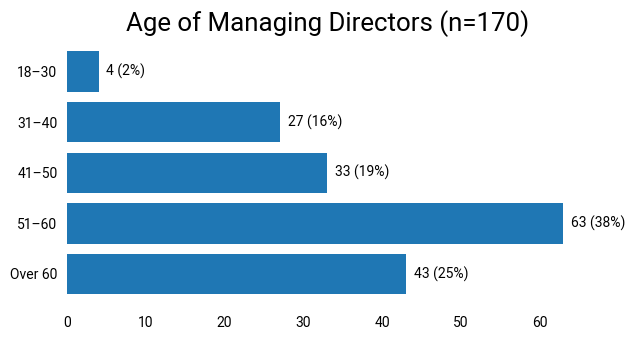
Age of managing directors. (Source: FIN21, graphic: finews)
15 Percent — And More to Come
The prevailing mood at the Zunfthaus zur Meisen was one of confidence. It is rooted in the self-image of Switzerland’s IAMs: a business that remains personal, entrepreneurial, and relationship-driven — strengths that may continue to matter even in an AI-driven world.
Or, as Cettier put it, only half in jest: with a market share of around 15 percent, «which means 85 percent is still up for grabs».
- << Back
- Page 3 of 3