Ant International Pushes AI Agents Into Payments and Treasury
Ant International is taking agentic AI deeper into financial services. The Singapore-based fintech group has unveiled a sweeping technology stack designed to let AI agents handle payments, accounts, foreign exchange and treasury tasks.
Ant International has launched its biggest product upgrade to date, rolling out close to 100 AI-native products across its four main business pillars: Alipay+, Antom, WorldFirst and Bettr.
The initiative covers payments, account management, foreign exchange, treasury and business growth. But behind the sheer number of new products lies a broader strategic shift: Ant International is preparing its financial infrastructure for a world in which AI agents do more than provide recommendations – they increasingly execute financial tasks themselves.
«The future fintech leader delivers two things: a future-ready trust infrastructure and foundational FinAI models [...] and a full stack of connected AI-native solutions,» Peng Yang, CEO of Ant International, told more than 1,100 executives at the company's annual Voyage merchant event in Shanghai.
AI Already Handling Payment Tasks
Ant International is not starting from scratch. Under Antom, its merchant payment business, 89.5 percent of merchants have already deployed AI agents, according to the company, while 81.4 percent of payment tasks were performed with AI assistance.
The scale of the underlying network is substantial. Ant International says it connects 150 million merchants with more than 2 billion consumer accounts through 53 digital wallets and 10 national QR payment schemes. Average daily transaction volumes exceed 25 million across 210 markets.
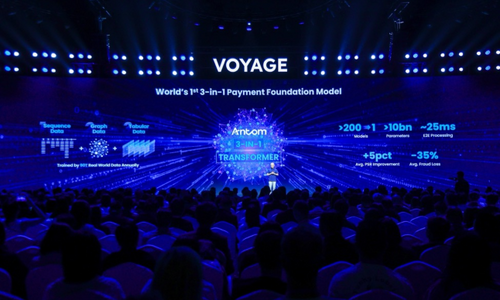
At the technology level, the new stack rests on two proprietary models. The Antom 3-in-1 Transformer is designed specifically for payments and processes sequential, tabular and graph data in a single architecture. Ant says the model has more than 10 billion parameters and processes 90 trillion data points annually.
The second model, FalconTST, focuses on FX and liquidity forecasting. According to Ant International, it has achieved accuracy of more than 93 percent in FX and cash-flow forecasting in real-world cases, while reducing corporate FX hedging and allocation costs by between 30 and 60 percent.
An Account Built for AI Agents
One of the most notable products is being introduced through WorldFirst, Ant International's global account business.
The company calls its new Account for Agent (AFA) the world's first fully agentic business account. It uses smart contracts combined with a Know-Your-Agent, or KYA, framework, as well as monitoring and intervention mechanisms designed to control what an AI agent is allowed to do.
This points to one of the key challenges emerging from agentic finance: if software can initiate financial transactions on behalf of companies or individuals, financial institutions need to establish not only who the customer is, but also which agent is acting, what it has been authorized to do and where its permissions end.
Ant is attempting to address this through its Alipay+ Agentic Mobile Protocol, or AMP. The open payment protocol is designed to enable AI agents to make payments through digital wallets, super apps and smart devices.
Since its launch in April, 10 Alipay+ wallet partners and seven acquirers have joined the first phase. Ant International is also working with Mastercard and Visa on interoperability for Know-Your-Agent security standards.
Who Pays When the Agent Gets It Wrong?
The expansion of AI agents into payments also raises a more fundamental issue: who bears the loss when an autonomous agent makes a mistake or is manipulated?
Ant International has introduced AgentSafePay to address that problem. According to the company, the product provides a full fund guarantee against losses resulting from risks specific to AI agents, including misinterpreted instructions and malicious prompt injection.
The broader security architecture combines conventional protection against fraud, scams and abuse with a second layer designed specifically for agentic transactions.
Importantly, Ant says users authorize an AI agent to perform a specific task rather than handing over control of the underlying account. The system is designed to provide real-time visibility into the agent's actions and clearly defined permission boundaries.
AI Moves Into Corporate Treasury
The push goes well beyond consumer payments. Ant International is also targeting corporate treasury departments.
WorldFirst's Treasury Autopilot is designed to forecast cash positions, manage liquidity, monitor FX exposures and recommend hedging strategies. Its Falcon Forecast can project cash flow, liquidity and foreign-exchange positions from minutes to months ahead.
Another component, Whale Pooling, uses real-time connectivity and AI-based decision-making to determine when, where and how much money should be moved within parameters defined by the client. Ant International says its same-day settlement rate exceeds 98 percent.
The underlying blockchain-based WhaleRTP platform already processed 45 percent of Ant International's cross-border volume in 2025, according to the company. Ant says the technology reduced working-capital requirements by 60 percent and increased interest income by 23 percent.
From AI Assistant to Financial Actor
The product offensive illustrates how quickly the role of AI in financial services is evolving. Much of the industry's initial adoption focused on chatbots, analytics and recommendations. Ant International is now moving toward systems in which AI agents can carry out parts of the financial workflow themselves – albeit within predefined controls.
That shift also explains the emphasis on identity, permissions, security and governance throughout the new platform.
The products will be rolled out across global markets during the fall and winter of 2026.