Capital Markets Day: Porsche Shifts Down to Speed Up
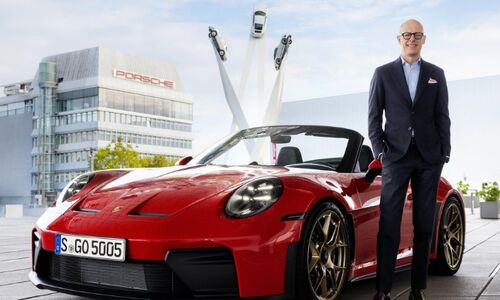
Michael Leiters wants to put the brand back on a winning track: lower costs, fewer managers, less China, more exclusivity and more combustion engines. finews was in Weissach on the eve of the Capital Markets Day.
Past Stuttgart, the landscape turns small-scale. Narrow country roads wind through fields and patches of forest, and through villages where the day still gets off to an unhurried start.
Our destination is Porschestrasse 911 outside Weissach, a temple of engineering. Ferry Porsche (1909–1998) had a circular test track built here in 1961, and a decade later development and design moved over from Zuffenhausen.
Today, several thousand engineers, designers and test drivers work on roughly 100 hectares, complete with a wind tunnel, a motorsport division and a test track of its own. The site embodies what Porsche's new management means by the word «Schmiede», or forge: the self-image of the Swabian tinkerers among whom Daimler, Bosch and Porsche grew up.
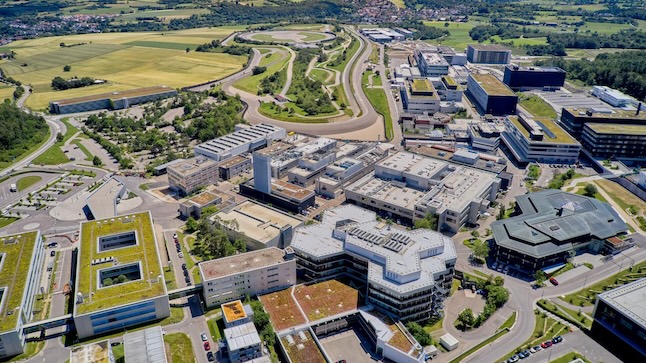
The development center covers more than 100 hectares. (Image: Porsche)
These days, however, the temple of engineering is mostly busy crunching numbers. New Chief Executive Michael Leiters is holding his first Capital Markets Day.
Capital Markets: No «Love Affair»
The recent history between capital markets and the sports carmaker has been fraught, to put it mildly. In September 2022, Volkswagen floated its sports car subsidiary at 82.50 euros a share.
Ahead of the Capital Markets Day, the stock trades at around 43 euros, barely half its listing price. It dropped out of Germany's blue-chip DAX index a little over a year ago.
In 2025, Porsche delivered 279,449 vehicles, 10 percent fewer than a year earlier. Its operating return on sales collapsed from 14.1 percent to 1.1 percent.
Then came the change at the top. Oliver Blume, who had run Porsche and the Volkswagen group simultaneously for years, handed the reins to Leiters at the start of 2026.
Leiters is a returnee. He once oversaw the Cayenne at Porsche, then spent eight years as chief technology officer at Ferrari and most recently ran McLaren.
The New Chief's First Real Test
Wednesday's Capital Markets Day is his first major test in front of investors. There, he is set to spell out the «Sportwagenschmiede '35» strategy in detail.
The day before, he faces the media, flanked by two fellow board members. Matthias Becker has been in charge of sales and marketing since February 2025, while Michael Steiner has headed development since 2016 and now serves as deputy chief executive.
In this lineup, the trio is not even ten months old. Interest is correspondingly high.
Around 50 journalists have made the trip, from «The Wall Street Journal», «The New York Times», «Bloomberg» and the «Financial Times» to Germany's «Handelsblatt» and «FAZ». They want to hear what strategy Porsche's leadership has tinkered together over the past months.
Putting the House in Order
«Putting our own house in order» is how Leiters sums up the first part of his strategy. He describes the environment without sugarcoating it.
The strong euro makes «life considerably harder,» he says, tariffs and fragile supply chains have become part of everyday business, and conditions in China have «fundamentally changed.» He does not expect any improvement.
What Porsche can influence above all is its own costs. That is the centerpiece of the first stage of «Sportwagenschmiede '35».
Cuts Start on the Executive Floor
On costs, the new chief starts with the executive floor. Over the years, Porsche has grown «disproportionately» in indirect functions and management layers, Leiters concedes.
The number of management positions is therefore set to fall by 40 percent over the medium term, and the overall workforce by 25 percent. Porsche even names 30 percent as its strategic goal.
The company has already agreed to cut around 9,000 jobs with employee representatives under its so-called future package.
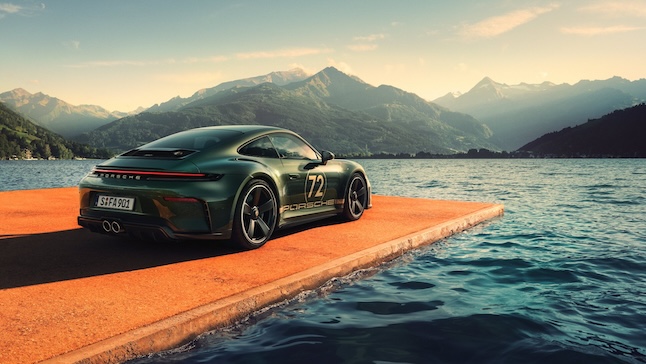
Focus on high-margin few-offs: the Porsche 911 GT3 90 F. A. Porsche. (Image: Porsche)
For the first time, dismissals are also on the table for management positions. Alongside natural attrition, voluntary departures and early retirement, Leiters names a fourth option: separation in exchange for a one-time severance payment.
Savings Along the Entire Chain
The savings run along the entire value chain. Development costs for future model lines are to fall by as much as 20 percent, labor costs in manufacturing by up to 30 percent and sales costs by 20 percent.
For new vehicle projects, Porsche wants to spend around 10 percent less on materials than previously planned. Steiner adds a line that is likely to rattle Weissach's self-image: «Technology leadership alone is no longer enough.»
Porsche aims to develop cars up to 40 percent faster. The development center itself is «non-negotiable,» Steiner says, but it must become more competitive.
The company is also shedding holdings. The stakes in Rimac and Bugatti Rimac have already been sold, the sale of consulting subsidiary MHP to Tata Consultancy Services has been signed, and development and production at battery unit Cellforce are being wound down.
Further exits are not ruled out. «This process is not complete,» Leiters says.
Pay slips are changing, too. The performance-related share of individual bonuses is set to rise from 10 percent to 30 percent, so that «nobody can hide.»
Breakeven Below 200,000 Cars
In the end, Porsche wants to make money with fewer than 200,000 cars sold a year, and that on deliberately cautious assumptions for China. Until now, the company had been geared to 350,000 vehicles and more, Leiters says.
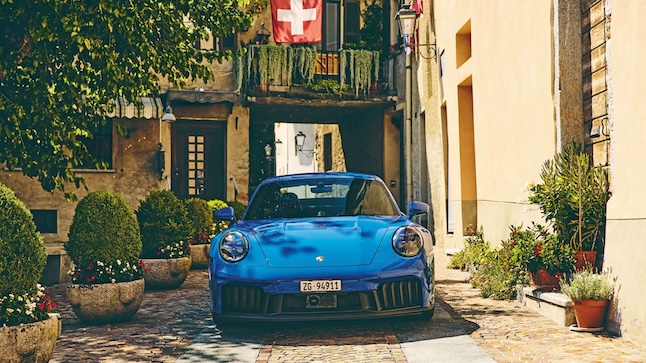
The current 911 Carrera GTS in Lugano Blue. (Image: Porsche)
Concrete financial targets were deliberately kept off the agenda at the media day. They are reserved for the capital markets and only appear in Wednesday's press release.
For the medium term, meaning 2030 and 2031, Porsche confirms its target of an operating return on sales of 10 percent to 15 percent on revenue of 41 billion to 45 billion euros. Over the long term, the goal is 15 percent.
In the first half of 2026, the margin stood at 7.8 percent, already a measurable improvement. Reaching the top of the range, however, will require a better economic, geopolitical and regulatory environment, Porsche writes.
After the Diet Comes the Product Push
«None of this happens overnight,» Leiters says. In the short term, the task is to shrink back to health; in the medium term, it is the product offensive, where he sees «the real momentum.»
That push begins with restraint. Porsche plans to cut the number of model variants by around 20 percent and in return sell 30 percent more cars per variant.
«Fewer derivatives mean more focus,» Leiters says. At the same time, the portfolio is shifting upmarket: Porsche aims to raise the share of models in the high-margin D and E segments by around 45 percent over the medium term.
Above the 911, Porsche is developing a mid-engine platform for a supercar. Leiters speaks of a firm commitment that this car will come.
A large SUV above the Cayenne, probably a seven-seater, is under review. Until 2030, at least one brand-defining model is to be launched every year.
Two Combustion Models for Every Electric One
The biggest course correction concerns the powertrain. «Many, including us, expected a faster and more even transition,» Leiters says of electric mobility.
Reality has proved «more complex.» Porsche is therefore sticking with combustion engines, plug-in hybrids and fully electric cars, and for every battery-electric model variant, two with combustion or hybrid drive are to follow.
In 2028, Porsche plans to unveil a new small SUV with combustion and hybrid powertrains, to be sold alongside the electric Macan. And for the purists, there is a guarantee: «I can assure you: the 911 will never be electric.»
The third pillar is the brand, in Leiters' words «the most valuable asset we have.» The very name of the strategy is a statement.
The term «Sportwagenschmiede» was deliberately left in German, Leiters says, because no English word fully captures «Schmiede»: a mindset, craftsmanship and precision, people working on something «until it feels right.»
Pricing Power in New Spheres
Becker translates that mindset into prices. «Value over volume» is the guiding principle, he says, as the foundation for «sustainable pricing power.»
The 10,000 most expensive Porsches sold in a year currently cost 270,000 euros on average. Over the medium term, that figure is meant to reach 330,000 euros.
Becker describes the brand as a union of apparent opposites: tradition and progress, performance and everyday usability, exclusivity and community, design and function. He puts its core this way: «We were born in racing.» And: «We build race cars in order to build sports cars.»
Porsche expects a great deal from personalization. In the Sonderwunsch program, which builds cars to customer specification all the way to one-offs, revenue is set to rise sixfold over the medium term.
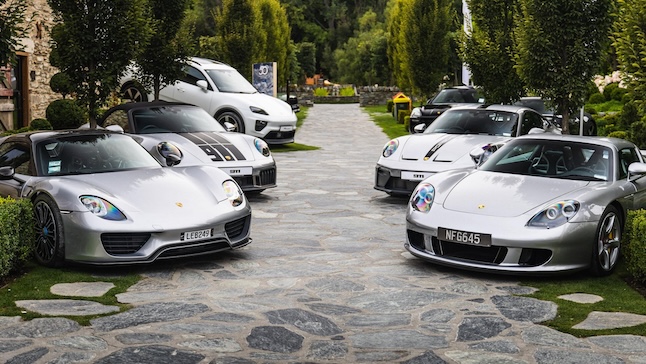
Porsche parade at the Ayrburn Classic in New Zealand. (Image: Porsche)
Echoes of Maranello
Listen closely and you hear echoes of Maranello, even if nobody here would ever say so: scarcity as a principle, racing as the brand's core, personalization and an emotionally charged community as sources of profit.
Whether customers will go along with higher prices, however, is the strategy's exposed flank. China in particular has shown how quickly even a strong brand can come under pressure.
Leiters' answer is as Swabian as it is self-assured: «Will it be easy? No. Will we make it? Yes.» He points out that the US market absorbed the price increases triggered by the new tariffs well.
Group Architecture Left Untouched
Porsche has no intention of turning entirely into Ferrari, though. «Value over volume» does not mean leaving the broader segment.
Leiters explicitly spans the range from the 911 as the «pinnacle of the sports car» to the Cayenne as the «all-rounder.» Becker calls that breadth one of the company's greatest trump cards: «We operate in the sweet spot between sporty premium and sporty luxury.»
Porsche wants to keep offering customers an «attractive entry into the brand» while growing at the top. In other words: earn high returns at the top, scale at the bottom.
Nor is the new chief shaking up the internal dynamics of the Volkswagen group. «The cooperation with Volkswagen remains important to us,» Leiters says, adding that it gives Porsche scale «where scale matters.»
Porsche shares the platforms for electric and combustion vehicles as well as the electronic architecture with Audi, and plans to rely «increasingly on industrial toolkits» going forward. In automated driving, Porsche deliberately does not want to be a pioneer but a «fast follower,» since everything it needs is available within the group.
Asked whether the Cayenne will be built in Bratislava or Leipzig in the future, Leiters is matter-of-fact: «Wherever we can build the car most profitably, that is where we will build it.» Porsche then illustrates the new strategy to journalists with two examples.
Mission S: A New Supercar Platform
The first is called Mission S, Porsche's foray into the very top of the market, a segment where it has so far been absent. Journalists were shown the concept of a first car at the media day, and capital market participants are likely to get a glimpse today; the official unveiling follows next week.
The company is announcing an entirely new mid-engine supercar platform that «enables a model line above the 911 sports car icon.» The platform is designed to be «highly flexible» and could thus underpin an entire model range.
The idea is not entirely new. In 2023, for its 75th anniversary, Porsche presented the Mission X study, a hypercar concept that was electric at the time.
A personnel decision shows how much weight the project carries. Since February, Tobias Suehlmann has led design; he came from McLaren and previously drew cars for Bugatti, Aston Martin and Bentley.
His approach is that of an archivist. «When I come to a brand, I study and inhale it. I go into the archive, I go into the museum,» he says.
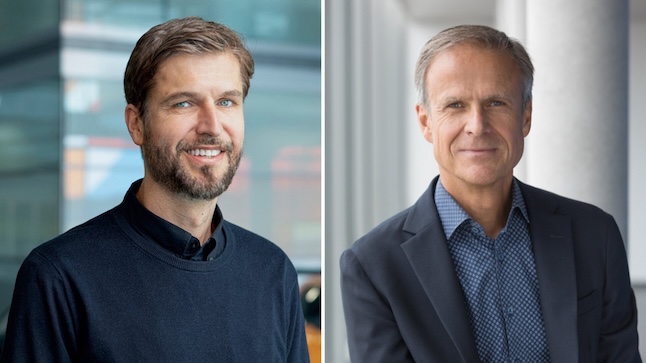
The man who came from McLaren: Tobias Suehlmann (left) with his predecessor Michael Mauer. (Image: Porsche)
Mission S is meant to be something «that strikes the heart,» form and function in one. What he dislikes seeing on cars is «fake»; you have to see the «muscles» where the car ends.
And the closer a Porsche gets to the racetrack, the more analog it may be in Suehlmann's view, right down to a mechanical rev counter and a real key. In the design studio, there is a «spirit of new beginnings,» he says: «It took off from day one.»
Monetizing Performance, Exclusivity and Heritage
The second example is less spectacular but highly relevant to the income statement. Under the banner «Home of Sports Cars,» Porsche is bundling three businesses: performance, including Manthey Racing, in which it has raised its stake to 67 percent; exclusivity, covering Sonderwunsch and Exclusive Manufaktur; and heritage.
«Race cars are the essence of who we really are,» says Alexander Fabig, who presents the unit. GT models used to be a niche.
Today, Porsche charges on average 53 percent more for a GT 911 than for a Carrera, and future projects could cost as much as three times a Carrera. For so-called few-offs, or ultra-limited series, Porsche typically asks for more than half a million euros.
At the top end, things get very exclusive. Around 15 Sonderwunsch projects are currently underway, priced between 1.62 million and 13.47 million euros per vehicle.
In «Factory Re-Commissioning,» Porsche rebuilds used cars at the factory, odometer reset to zero included. Eleven such cars have been completed, 16 are in progress and 21 are on order.
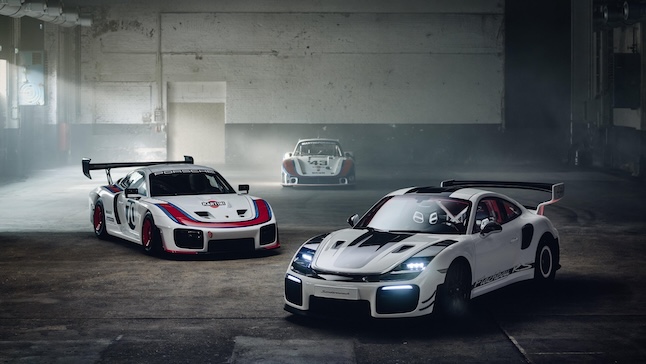
The Porsche Flachbau RS (right). (Image: Porsche)
The Sonderwunsch
The very first Taycan Turbo from the Sonderwunsch program went to a Swiss customer. And Porsche is currently working on a very large re-commissioning order from Switzerland, including a custom-built carbon exhaust system.
The volumes are small, the margins large. By the medium term, Sonderwunsch revenue is set to increase sixfold.
A Cautious, Wait-and-See View of China
On the sidelines, it is striking how Porsche is executing a retreat. In 2020, a good third of its sales came from China; today it is less than 10 percent.
In the first half of 2026, sales there plunged by another third. Leiters speaks of a «self-destructive price war» that in the long run is not sustainable even for Chinese manufacturers.
Porsche is drawing its conclusions. The number of dealers is to fall from around 150 to 75 to 80 by the end of the year, and the new breakeven point rests on an explicitly «very conservative» China plan.
Porsche is betting on «attractive niches instead of chasing volume.» Giving up on the market, however, is not an option.
Where the Battery Takes the Engine's Place
In the afternoon, things get technical. «Every Porsche must feel unmistakably like a Porsche,» says Robert Meier, who is responsible for vehicle architecture.
He shows how that translates into hardware with two examples. The Cayenne gets a new active suspension.
«The damper no longer just absorbs forces, it applies them, at every wheel, in real time,» Meier says. The SUV is meant to handle significantly better in corners and under braking as a result.
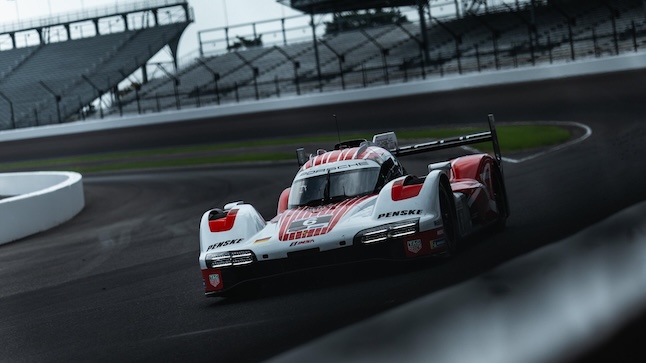
Racing as the brand's core: the Porsche 963 of Porsche Penske Motorsport at the North American IMSA Championship in Indianapolis. (Image: Porsche)
Even more revealing is the electric 718, which has yet to be officially presented. How do you carry the mid-engine principle of balance, agility and precision over to a battery car?
Porsche's answer: the battery does not lie flat in the floor as usual but is stacked behind the cockpit, where the engine used to sit. Weight distribution thus comes close to that of a mid-engine car, and the seating position stays low.
The battery weighs somewhere around 450 kilograms, roughly 1,000 pounds, and runs on 800-volt technology.
Riding Shotgun With a Racing Driver
We find out how that feels at the end of the day on the development center's hill circuit. The 2.88-kilometer track, about 1.8 miles, was completed in 1966.
With the Obermeister corner, the Z-slope and the Bott chicane, it winds so tightly that the legendary 917 turned its first laps here. Behind the wheel of the 718 Boxster Electric sits Timo Bernhard, a two-time overall Le Mans winner and record holder on the Nuerburgring Nordschleife; we are in the passenger seat.
The car accelerates the way you would expect an electric car to. The surprise is the braking.
In the selected drive mode, the Boxster simulates downshifting, with jolts and sound, as if it had a gearbox. Steiner had spoken that morning of «authentic sound» and electronic shifting; here, you can hear and feel it.
The professional at the wheel is visibly enjoying himself. At Porsche, the powertrain is partly negotiable, then, but the driving feel is not.
Now the sports carmaker has to prove it can forge returns again, too.