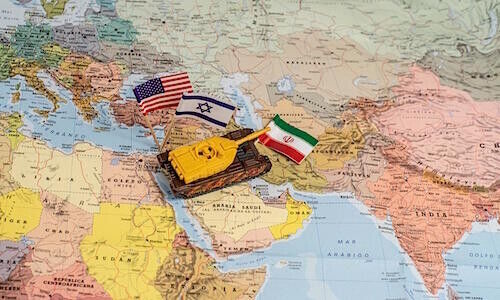
US-Israel-Iran Conflict: What is the Base Case?
The US-Israel-Iran conflict continues to unfold and markets are closely monitoring for hints of what to expect. Banks share their views on their base case and how things could play out.
The US-Israel-Iran conflict, dubbed «Operation Epic Fury», continues to intensify and expand across the Middle East with the total death toll reportedly surpassing 1,000.
According to the base case of multiple banks, the conflict is most likely to be relatively short-lived with limited escalation and limited disruption.
«Few Weeks War»
At Standard Chartered, a March 4 report went as far as attributing a 60 percent probability for the war to last a «few weeks» with forecasts for a 3 percent upper bound Fed fund rate, S&P index reaching 7,800, a US 10-year Treasury yield of 3.75 percent and $5,350 per ounce of gold.
A Lombard Odier note on March 2 also called for limited escalation with negligible impact on US headline inflation and growth, resulting in three Fed rate cuts.
Limited Oil Shock
In light of the optimism, the most agreed upon outcome is for energy supply and prices to experience only a temporary shock. Standard Chartered expects oil to rise briefly towards $80 per barrel before retracing to approximately $60 per barrel. A March 3 note by Indosuez Wealth Management forecasts a retracing to $60–70 per barrel.
«We expect the current spike in the price of oil to reverse, at least partially, once it becomes clearer that transit disruptions are likely to prove temporary, most critical oil infrastructure remains intact, and the imperative for continued military action fades,» UBS said in a separate note on March 3.
«In this scenario, markets may prove volatile over the coming weeks, but would likely thereafter start to refocus on positive global economic fundamentals. This would be in line with the impact of most geopolitical shocks in recent history.»
Despite consensus, it is worth noting that none of the aforementioned banks rule out the likelihood of a prolonged conflict with more severe consequences. This includes sustained energy disruption with higher prices for longer, worldwide consumer inflation, and even the risk of a global recession.