Asia’s Wealthy Seek Safety — But Many Lack a Clear Investment Strategy
Asia-Pacific’s wealthy investors remain surprisingly optimistic despite mounting geopolitical tensions, inflation concerns and market volatility. Yet a new study by private bank Lombard Odier reveals a striking contradiction: many high-net-worth individuals (HNWIs) pursue ambitious investment goals without having a clearly structured portfolio strategy.
For the report, Lombard Odier and its strategic partners surveyed more than 390 HNWIs across Australia, China, Hong Kong, Japan, Malaysia, Singapore, Taiwan, Thailand and the Philippines.
Recession and market crashes top investors’ concerns
The biggest fear among Asia’s wealthy remains an economic downturn. Some 53,5 percent of respondents identified recession as the greatest threat to their portfolios over the next three years. Concerns over a major equity market correction (48,1 percent), trade wars and persistent inflation also ranked highly.
Regional differences are significant. Investors in Taiwan, Hong Kong and the Philippines expressed the greatest concern about trade wars, reflecting the region’s exposure to ongoing US-China tensions.
Cybersecurity risks, meanwhile, remain surprisingly low on investors’ radar despite rapid digitalisation and the rise of artificial intelligence. Only 17,9 percent of respondents cited cybersecurity as a major concern, although younger generations showed considerably more awareness of the issue than older investors.
Investors feel increasingly overwhelmed
One of the report’s strongest themes is the growing need for financial education and advice. Around 38 percent of respondents see taxes and regulation as major obstacles to achieving their financial planning goals, while 33 percent admit they lack sufficient knowledge to manage their wealth effectively.
Time is another major issue. Nearly one-third of respondents say they simply do not have enough time to actively manage their financial affairs.
Younger investors appear particularly exposed. Among Gen Z respondents, 65 percent said they lack financial planning knowledge, while 60 percent cited lack of time as a major challenge.

(Source: Screenshot Lombard Odier)
Strong confidence despite weak portfolio structures
Despite these concerns, confidence levels remain remarkably high. More than 80 percent of respondents believe their portfolios are adequately structured to achieve their long-term wealth goals.
This is where Lombard Odier identifies a major paradox. Only around one in five investors actually follows a comprehensive asset allocation strategy.
The gap is especially pronounced among younger generations. While roughly one-third of Baby Boomers say they follow a clear asset allocation framework, only 5 percent of Gen Z respondents do the same. At the same time, 35 percent of Gen Z investors admit they either lack a clear strategy altogether or are unsure how their portfolios are structured.
Liquidity and diversification dominate portfolios
The survey points to a broad shift toward more defensive positioning. Nearly half of respondents want to diversify further, while 45,3 percent aim to increase liquidity.
As a result, cash and highly liquid assets remain extremely popular. Almost three-quarters of respondents already hold substantial liquidity positions, and nearly 39 percent intend to increase those allocations further over the next 12 months.
Equities, however, continue to play a central role. Around 67,5 percent of respondents currently invest in listed stocks. Taiwan stands out in particular, with more than 80 percent of investors holding equities following the strong performance of Taiwanese markets in 2025.
Younger generations embrace risk
While older investors are increasingly defensive, younger generations are moving in the opposite direction. Gen Z and Millennials are showing greater appetite for private markets, family businesses and digital assets.
Among Gen Z respondents who do not yet own equities, 60 percent plan to start investing in stocks within the next 12 months. Interest in private and non-listed companies is also particularly strong among younger investors.
Cryptocurrencies reveal an even sharper generational divide. While Millennials and Gen Z respondents plan to maintain or increase their exposure to digital assets, 71,4 percent of Baby Boomers intend to reduce their holdings.
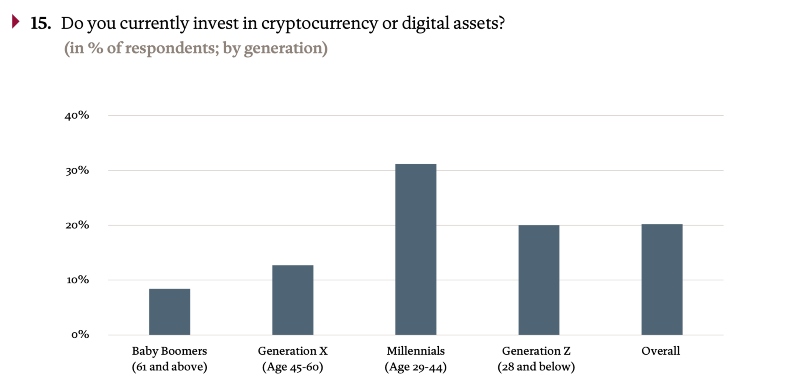
(Source: Screenshot Lombard Odier)
Professional advice emerges as a key differentiator
One of the clearest findings of the study is the impact of professional advice. Investors who receive advisory support tend to build more diversified portfolios, invest more actively in private markets and family businesses, and show greater confidence in their overall asset allocation decisions.
Yet fewer than half of respondents currently seek professional investment and wealth management advice.
For Lombard Odier, this highlights a major opportunity. In an increasingly complex investment environment, the key advantage is no longer access to information — but the ability to interpret it correctly.