
The 2025 Event That Revealed Singapore’s Next Financial-Center Playbook
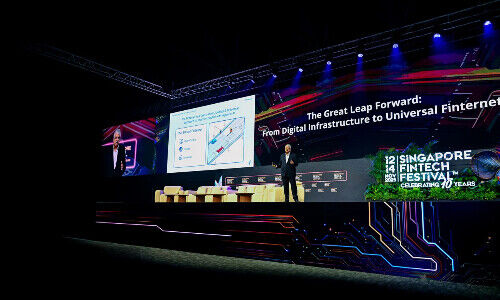
If there was a single week in 2025 when Singapore most clearly «priced» its ambitions as a global financial center, it was the 10th edition of the Singapore Fintech Festival.
Singapore Fintech Festival’s scale has become part of its strategic utility. The 2025 (SFF) edition drew more than 70,000 participants from 142 countries and regions, with 900+ speakers across ~300 sessions, and an invite-only Insights Forum that convened 2,300+ policymakers, regulators, investors and industry leaders across 80 sessions.
That footprint matters because Singapore’s financial model depends on being a convening node: a place where regulators, capital providers, banks, asset managers, and infrastructure operators can align on standards and interoperability – then operationalise those standards across Asia and, increasingly, across major Western counterparties.
The 2025 programming also sharpened the technology stack that Singapore wants to be «best in class» at: AI, tokenisation, and quantum-readiness were positioned as the three frontier capabilities likely to be embedded in core financial infrastructure, not just fintech wrappers.
From Pilots to Production Pathways
The most market-relevant moments at SFF 2025 were not about consumer fintech. They were about wholesale plumbing: what «money» means on-chain, how settlement happens, and how to regulate instruments that increasingly blur banking, payments, and capital markets.
During SFF, the Managing Director of the Monetary Authority of Singapore (MAS), Chia Der Jiun, said, Singapore was preparing draft legislation for its stablecoin regulatory regime, with emphasis on reserve backing and redemption reliability.
For issuers and investors, the signal is straightforward:
- Singapore is positioning stablecoins less as speculative instruments and more as regulated settlement assets suitable for institutional workflows.
- A «redemption-first» framing implies stablecoins will be treated like payment instruments with bank-like obligations, not merely digital commodities.
Tokenised MAS Bills and the Settlement Stack
Chia also said MAS would run trials to issue tokenised MAS bills, and expand experiments you can read as Singapore’s attempt to define a tokenised «risk-free curve» for on-chain finance.
This matters because tokenisation only becomes economically meaningful when (a) high-quality collateral exists natively in the same rails, and (b) settlement finality is credible at scale. Tokenised short-dated government instruments can serve as that collateral layer—enabling repo-like financing, margining, and liquidity management within tokenised markets.
Cross-Border Interoperability
A key Singapore advantage is not domestic market size; it is the ability to intermediate cross-border flows with trusted rules. At SFF, MAS pointed to collaborations with other central banks aimed at cross-border transactions and digital assets – including experiments for real-time FX interoperability and work on cross-border digital asset settlement.
For institutional participants, this is the most investable thesis embedded in Singapore’s policy: if Singapore becomes the jurisdiction where tokenised collateral, tokenised money, and compliant cross-border settlement standards converge, then a growing share of regional wholesale activity will route through its institutions, infrastructure providers, and legal/regulatory perimeter.
Rebuilding Singapore’s Public Equity Market
While SFF framed the future of financial infrastructure, Singapore also advanced a separate 2025 agenda: making its public markets more attractive to issuers and more liquid for investors.
In February 2025, Singapore announced measures to rejuvenate its equities market, including:
- a 20 percent corporate income tax rebate for new primary listings (and 10 percent for certain secondary listings), and
- a S$5 billion equities-focused investment programme to support domestic stocks.
The logic mirrors what Singapore is doing in tokenisation: remove coordination problems. Tax incentives address issuer economics; anchored capital addresses liquidity and market depth – especially beyond index names.
The EQDP
By July 2025, MAS said it would place an initial S$1.1 billion with three asset managers –Avanda Investment Management, JP Morgan Asset Management, and Fullerton Fund Management – as part of the broader S$5 billion programme (EQDP), with more co-investments to follow.
For a financially sophisticated audience, the nuance is important: MAS is not attempting to prop up prices directly. It is attempting to catalyse:
- sustained buy-side research and engagement in Singapore-listed equities,
- improved liquidity in small/mid caps, and
- a more competitive ecosystem for listings.
Whether this works will depend on second-order effects (research coverage, market-making incentives, governance quality, and whether listings are «compelling» in sector mix), but the policy direction is unambiguous: Singapore is willing to spend real balance-sheet resources to keep its equity market relevant.
What to Watch Next
For investors and operators, SFF 2025 effectively laid out Singapore’s «next-decade» financial-center playbook:
- Regulated digital money becomes infrastructure
The biggest opportunities will sit in compliance-grade issuance, custody, settlement, collateral management, and risk controls – less in retail-facing crypto narratives. The stablecoin legislative path and tokenised bill trials are the clearest tells.$ - Interoperability is the product
Singapore is not just competing on innovation; it is competing on being the jurisdiction where large institutions can agree on rules and run cross-border workflows. - Public markets get a policy backstop
The equities reforms and the EQDP suggest Singapore is treating capital markets competitiveness as a strategic asset, not a passive outcome.
Bottom Line
SFF 2025 was the main financial-centre event of the year in Singapore because it showcased policy, capital, and technology moving in the same direction.
The immediate trade is not «fintech hype»; it is the slow but potentially durable repricing of Singapore as a hub for regulated tokenised finance – while simultaneously attempting to restore momentum in its listed equity market.