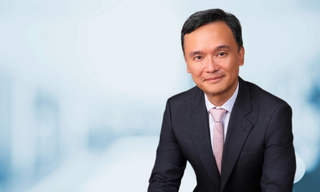

Lumen's Tan Sheng Yong: «In 2026, I See Risks On Two Distinct Fronts»
As global markets move toward 2026, investors are navigating a landscape shaped by fragmentation, shifting policy regimes, and the transformative, but uneven, impact of artificial intelligence. Tan Sheng Yong, Chief Investment Officer of Lumen Capital Investors, explains in an interview with finews.asia, how global asset allocators should rethink portfolio construction amid changing correlations and heightened uncertainty.
Sheng Yong, how would you characterize the investment landscape as we head into 2026?
We approach 2026 with a constructive but cautious view on global growth. The US economy certainly has momentum, underpinned by the productivity promise of AI and industrial policy tailwinds. However, the backdrop is becoming more complex.
With sticky inflation pockets and shifting labour demographics, the ‹goldilocks› scenario is harder to maintain, leaving the Federal Reserve (Fed) with very little margin for error.
We are also seeing «Global Strife» – from trade tariffs to leadership changes – creating a much more fragmented world. We are seeing correlations shift; stocks and bonds are no longer consistently moving in opposite directions. For 2026, the global economy is being reshaped. You need to be far more selective about where you are exposed.
Given this backdrop, where do you see the biggest pitfalls for investors today?
I see risks on two distinct fronts: structural and behavioural.
Structurally, we are witnessing a shift toward what I call «Geoeconomic Realignment.» We are moving into an era where national priorities – specifically industrial and technological independence – supersede traditional market forces.
«You cannot afford to be static in an agile world»
This fragmentation means the world is no longer moving in one synchronized economic cycle. We now have to be mindful of multiple divergent scenarios and be ready to pivot accordingly. In this environment, agility is the new stability.
This brings me to the behavioural risk: complacency in cash. Many investors are still holding static cash positions because it felt safe and yielded 5 percent in 2024. But as rates fall and the landscape shifts, that safety is an illusion. You cannot afford to be static in an agile world.
In short, in a world that’s fragmenting and evolving faster than ever, the real pitfall isn’t taking risks – it’s standing still.
Are we in an AI bubble, or is the current enthusiasm around AI justified?
It depends on how we define a bubble. In the short term, markets may be overestimating immediate productivity gains while underappreciating the scale of infrastructure required for widespread AI adoption – from energy and cooling to advanced semiconductors and data-centre capacity.
«AI reflects a secular theme, not a cyclical fad»
The debate on AGI adds another layer: the perceived pace of progress influences sentiment and valuation, even though the economic value will be realized in stages, long before AGI itself.
What is clear is that AI has been a dominant driver of flows from 2023-2025, and that reflects a secular theme, not a cyclical fad.
Moving into 2026, we think the AI investment theme can continue, but returns should increasingly be driven by earnings growth rather than climbing valuations.
How should global asset allocators reconsider their allocation to US equities in today’s context?
It is an important discussion and one that frequently comes up in our conversations with fund managers.
The US has delivered exceptional performance, driven largely by the AI theme and strong earnings growth. However, there are several factors that warrant a more balanced stance as we move into 2026.
First, the policy landscape is far less predictable. Changes introduced by the current administration, particularly around trade realignment, industrial policy, and technology controls, are unlikely to unwind quickly, irrespective of the outcome of the next presidential election.
«The risk-reward now looks more nuanced»
Meanwhile, with 2026 being a mid-term election year, history tells us SPX returns are often more muted as policy signalling becomes less decisive and market positioning turns cautious.
Second, US equities have seen a significant run-up. While earnings momentum remains strong, we believe the risk-reward now looks more nuanced.
Reducing our overweight to a more neutral stance allows us to acknowledge both realities: the undeniable earnings strength and the concentration risk, valuation stretch, and policy uncertainty.
To be clear, the US remains a core allocation for global portfolios given its market depth, innovation leadership, and the sheer scale of its corporate ecosystem.
However, the case for complementing US exposure with other regions and asset classes has strengthened, particularly where valuations and policy support present a more favourable risk-reward dynamic.
How are you positioned in your discretionary portfolios today?
In our discretionary portfolios, we run a global multi-asset, beta-plus approach focused on delivering resilient and risk-adjusted returns. Our approach balances long-term structural themes with opportunities where we believe risk-reward is more attractive and underappreciated.
«We do not expect the current winners in the AI build-out to remain the sole beneficiaries indefinitely»
First, we have moderated our exposure to the US-centric AI leadership. While the long-term structural story remains intact, the near-term concentration and valuation dynamics justify a more balanced stance. Importantly, we do not expect the current winners in the AI build-out to remain the sole beneficiaries indefinitely.
Over time, value is likely to shift from hyperscalers and enablers toward broader AI adopters across industries. Positioning for that evolution means diversifying across the AI value chain and geographies – including Asia ex-Japan, where we are overweight China tech – and selectively into parts of the market where valuations are more attractive, and earnings sensitivity to AI adoption is underappreciated.
Secondly, we like dividend-focused equities – companies that balance reinvestment with returning cash to shareholders. They offer more predictable cash flows and a differentiated profile that is less correlated to the AI-driven, capital-intensive parts of the market.
In today’s environment, tangible shareholder returns provide a useful counterbalance to future growth narratives.
Third, we see attractive opportunities in emerging market local-currency debt. Improving macro fundamentals, attractive carry, and a muted dollar trajectory create a compelling total return profile that is not yet fully priced in.
«Gold plays a vital role in an environment shaped by geopolitical uncertainty»
We’re also revisiting hedge funds with fresh conviction. The shift away from a zero-interest-rate environment has reshaped the opportunity set – reintroducing dispersion and credit differentiation, conditions that historically favour skilled, alpha-driven managers.
And finally, we continue to view gold as a strategic hedge. While investor positioning is elevated, gold still plays a vital role in an environment shaped by geopolitical uncertainty, currency debasement risk, and shifting asset correlations.
Tan Sheng Yong is a seasoned investment professional who currently serves as Chief Investment Officer (CIO) of Lumen Capital Investors in Singapore. Prior to joining Lumen, he was the CIO and Co-Founder of Aument Capital Partners, where he led the firm’s discretionary portfolio management and global multi-asset investment strategy. Earlier, he held roles across private banking, investment advisory, and asset management, including positions at DBS Private Bank, EFG Bank, and J. Safra Sarasin. He later transitioned into hedge fund analysis and portfolio management. He holds the Chartered Financial Analyst (CFA) designation, along with the Financial Risk Manager (FRM) and Certificate in Investment Performance Measurement (CIPM) credentials.