
Asian Banks Surge as Investors Reprice Financial Powerhouses
A sharp re-rating lifts the world’s largest banks into 2026 with renewed momentum.
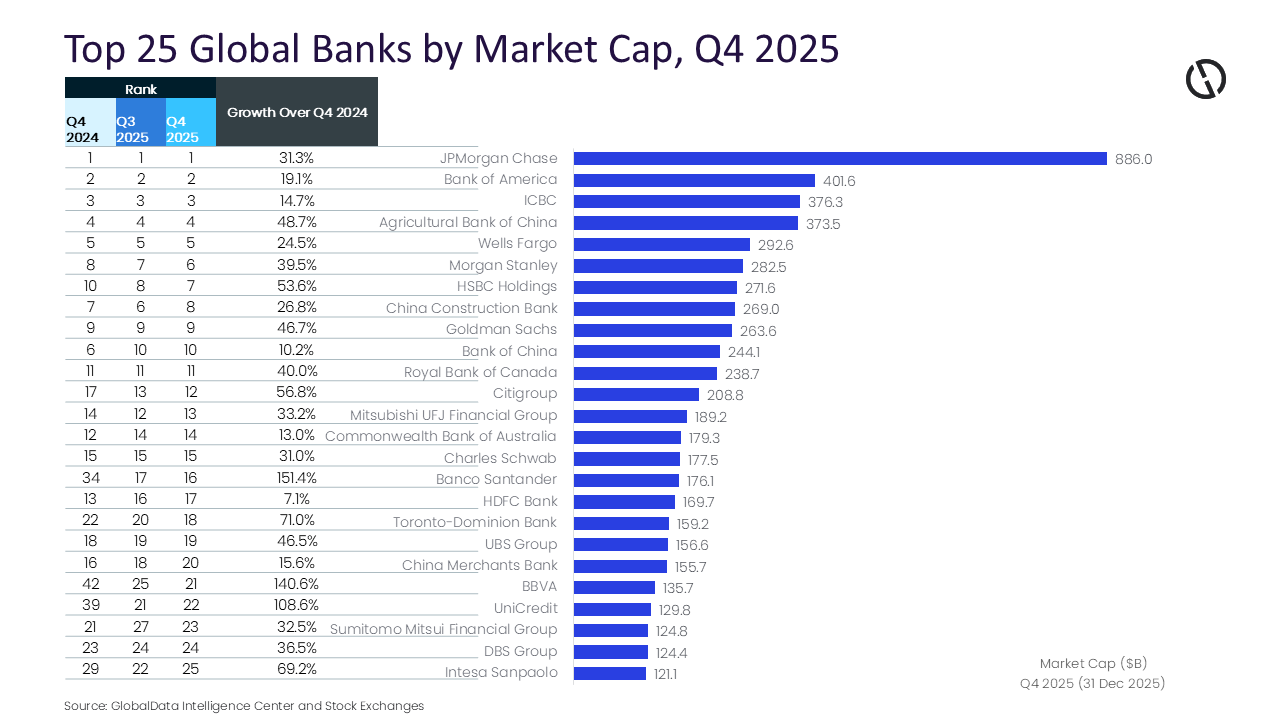
The world’s 25 largest banks closed 2025 with a powerful surge in market value, as aggregate market capitalization climbed 35.8 percent year on year to $6.1 trillion in the fourth quarter, according to newly released data from GlobalData.
China’s largest lenders maintained their presence at the top of the global table, buoyed by vast domestic franchises and cautiously improving investor confidence. Industrial and Commercial Bank of China ranked third globally, posting a 14.7 percent increase in market value to $376.3 billion.
Agricultural Bank of China stood out with a 48.7 percent rise, narrowing the gap with its larger peers. China Construction Bank and Bank of China remained in the top ten, as investors drew reassurance from policy support and stabilizing asset-quality trends despite an uneven economic recovery.
Asia-Pacific Leaders Strengthen Regional Influence
(Click to enlarge; source: GlobalData)
Beyond China, Asia-Pacific banks reinforced their role as regional champions. Japan’s Mitsubishi UFJ Financial Group and Sumitomo Mitsui Financial Group recorded market-cap gains of 33.2 percent and 32.5 percent, respectively, benefiting from improved rate dynamics and steady fee income.
Singapore’s DBS Group advanced 36.5 percent, cementing its status as a leading Southeast Asian franchise. In emerging markets, India’s HDFC Bank delivered a more modest 7.1 percent increase, yet it remains one of the developing world’s most valuable banks.
Most Dramatic Rebound in Europe
European banks delivered the most dramatic rebound, reversing years of subdued valuations. Spain’s Banco Santander emerged as the standout, with market value soaring 151.4 percent to $176.1 billion, propelling it from 34th to 16th place globally.
BBVA followed closely with a 140.6 percent rise, while Italy’s Unicredit and Intesa Sanpaolo advanced 108.6 percent and 69.2 percent, respectively.
As GlobalData analyst Murthy Grandhi noted: «These outsized moves signal a decisive shift in investor sentiment toward Europe’s banks after years of restructuring, tighter cost discipline, and stronger net interest margins in a higher-rate environment».
US Giants Consolidate Dominance
American banks continued to anchor the global rankings, underscoring the scale and earnings power of US financial institutions. J.P. Morgan Chase retained its position as the world’s most valuable bank, with market capitalization rising 31.3 percent to $886 billion.
Bank of America held second place after a 19.1 percent increase to $401.6 billion, supported by diversified revenue streams and solid capital-markets activity. The resurgence in dealmaking late in the year further lifted investment banking leaders, with Morgan Stanley up 39.5 percent and Goldman Sachs gaining 46.7 percent on strong trading, advisory, and wealth-management performance.
Measured Optimism For 2026
Heading into 2026, the global banking sector appears positioned for steady, if less explosive, progress. Strong capital ratios, improved risk controls, and diversified revenue bases provide a solid foundation, while digitization and cost discipline continue to enhance efficiency.
GlobalData expects moderating inflation, uneven growth, and gradual rate cuts to support asset quality and lending, albeit with some pressure on net interest margins from recent peaks.
As Grandhi cautions: «Key risks include geopolitical tensions, weaker trade, policy-driven market volatility, China-related uncertainty, and ongoing commercial real-estate stress, particularly for US regional lenders».