
Beyond Champagne and Lie-Flat Seats – Redefining Business Class
Flying Business Class for work still draws envy and ironic remarks, fueled by a well-worn image of champagne, extra legroom, and indulgence at 30,000 feet. For seasoned executives and frequent business travelers, however, this narrative misses the point, writes finews.asia founder Claude Baumann.
High expectations, compressed schedules at destination, and the need to manage jet lag efficiently make comfort, privacy, and reliability far more than indulgent extras – they are productivity enablers.
Against this backdrop, Business Class emerged in the late 1970s as airlines sought to offset declining demand for costly First Class tickets while differentiating themselves in an increasingly competitive market.
British Caledonian pioneered the concept in 1978. Since then, two developments have reshaped the experience decisively – smoking bans on board and seats that convert fully into beds. These changes have redefined both comfort standards and passenger behavior.
Dress Codes Down, Expectations Up
(Image: Air France Business Class, handout)
The transformation of the cabin has also changed passenger culture. Where suits, ties, and tailored outfits were once mandatory, today even Business Class travelers may board in shorts or sleepwear. The casualization may clash with the elegant cabin interiors, but it reflects a broader shift – Business Class is now optimized for rest, not ritual.
Only months after British Caledonian, PanAm, and Air France introduced their own Business Class products in 1978. While «Caledonian» and PanAm have long disappeared, Air France continues to shape the segment. Since September 2022, the airline has been rolling out a new Business Class on its long-haul Boeing 777-300 fleet, reinforcing its ambition to lead rather than follow.
Service as a Differentiator
(Image: Julien Royer in the business class galley; Image: handout)
Air France frames its strategy as a revival of «the French art of travel». The phrase may sound generic, but execution matters. Where some airlines struggle with impersonal or overly automated service, Air France relies on attentive cabin crews, subtle humor, and a distinctly human touch – a competitive advantage that cannot be replicated by hardware alone.
Catering quality meets high expectations – and increasingly strict sustainability criteria. Business Class passengers can preselect meals before departure to reduce food waste, while single-use plastics have been largely eliminated.
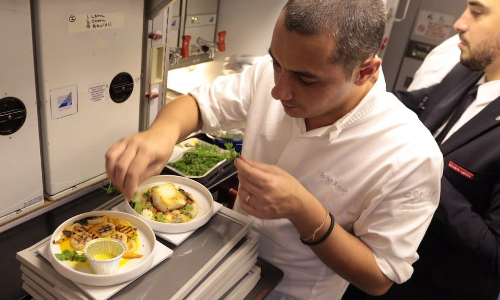
Menus are created in collaboration with three-Michelin-star chef Julien Royer of Odette in Singapore, while wine selections – predominantly French – are curated by Xavier Thuizat, head sommelier at iconic Hôtel de Crillon.
Strategic Seating
(Image: Air France Business Class, handout)
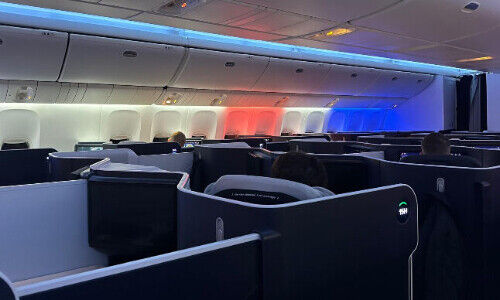
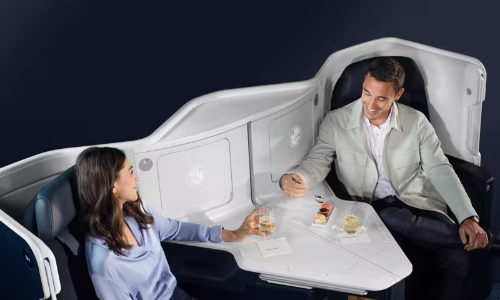
Air France’s Business Class seat concept revolves around three pillars. Full Flat – seats convert into fully flat beds nearly two meters long and 70 centimeters wide. Full Access – a 1-2-1 configuration ensures direct aisle access for every passenger. Full Privacy – sliding doors create a suite-like environment, shielding travelers from cabin traffic and visual disturbance.
Technology as Comfort Infrastructure
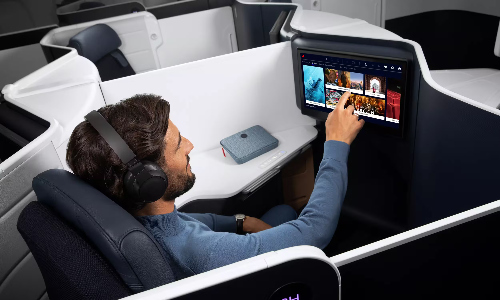
The physical product is reinforced by technology. High-definition touchscreens measuring 44 centimeters, noise-reducing headphones, adjustable ambient lighting, Bluetooth connectivity, wireless phone charging, and multiple power outlets are standard.
A digital library offers around 350 films, extensive music and podcasts, and more than 500 hours of entertainment – designed to keep travelers productive or well-rested.
Pricing Nuances Matter
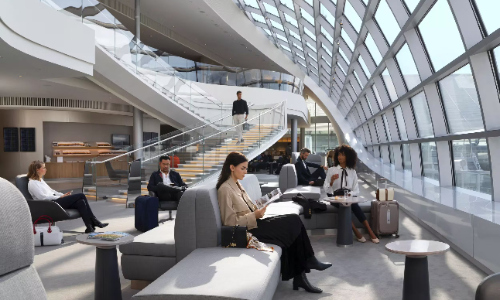
Business Class lounge at Paris-CDG airport (Image: Air France)
Financially savvy travelers should note that Air France offers a Business Light fare. Lounge access, seat selection, and additional baggage are excluded and charged separately, with only one checked bag included.
Careful fare comparison before booking is therefore essential.
Scale, Network, and Premium Ground Services
Founded in 1933, Air France now serves around 200 destinations from its Paris–Charles de Gaulle hub and carries more than 70 million passengers annually. Its Business Class lounge in Terminal 2E, Hall L, reflects the premium strategy – spacious design, a sauna, and complimentary Clarins spa treatments elevate the ground experience.
After all, Business Class is no longer just about visible luxury. For airlines like Air France, it is a strategic product combining productivity, sustainability, and brand differentiation.
Growth Through Alliances and Acquisitions
The French carrier merged with KLM in 2004, creating the Air France-KLM holding, and is a founding member of the SkyTeam alliance. The Flying Blue loyalty program enables miles to be earned and redeemed across partners, including KLM, Delta Air Lines, and Aeroméxico.
By next year, the group is set to acquire 60 percent of Scandinavian Airlines SAS, further expanding network reach.
When Business Class Is Not Enough
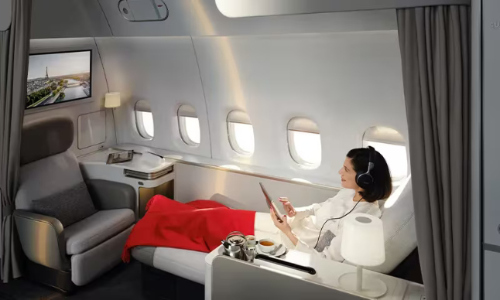
First Class à la française (Image: Air France)
For travelers seeking the absolute top tier, Air France has doubled down on First Class rather than abandoning it. While many airlines – including partner KLM – eliminated First Class decades ago, Air France continues to invest heavily in this segment and has just recently expanded its offer on additional routes to several US destinations and Tel Aviv.
La Première offers expansive suites with five windows per cabin and a service level that surpasses even an already comprehensive Business Class product. It is a deliberate brand statement – reinforcing Air France’s positioning at the premium end of global aviation.
And for those fortunate enough to experience it, the envy and ironic remarks from colleagues are likely unavoidable – and, perhaps, entirely justified.